British Airways Emergency Flight BA286: Full Explanation, History, and Verified Details
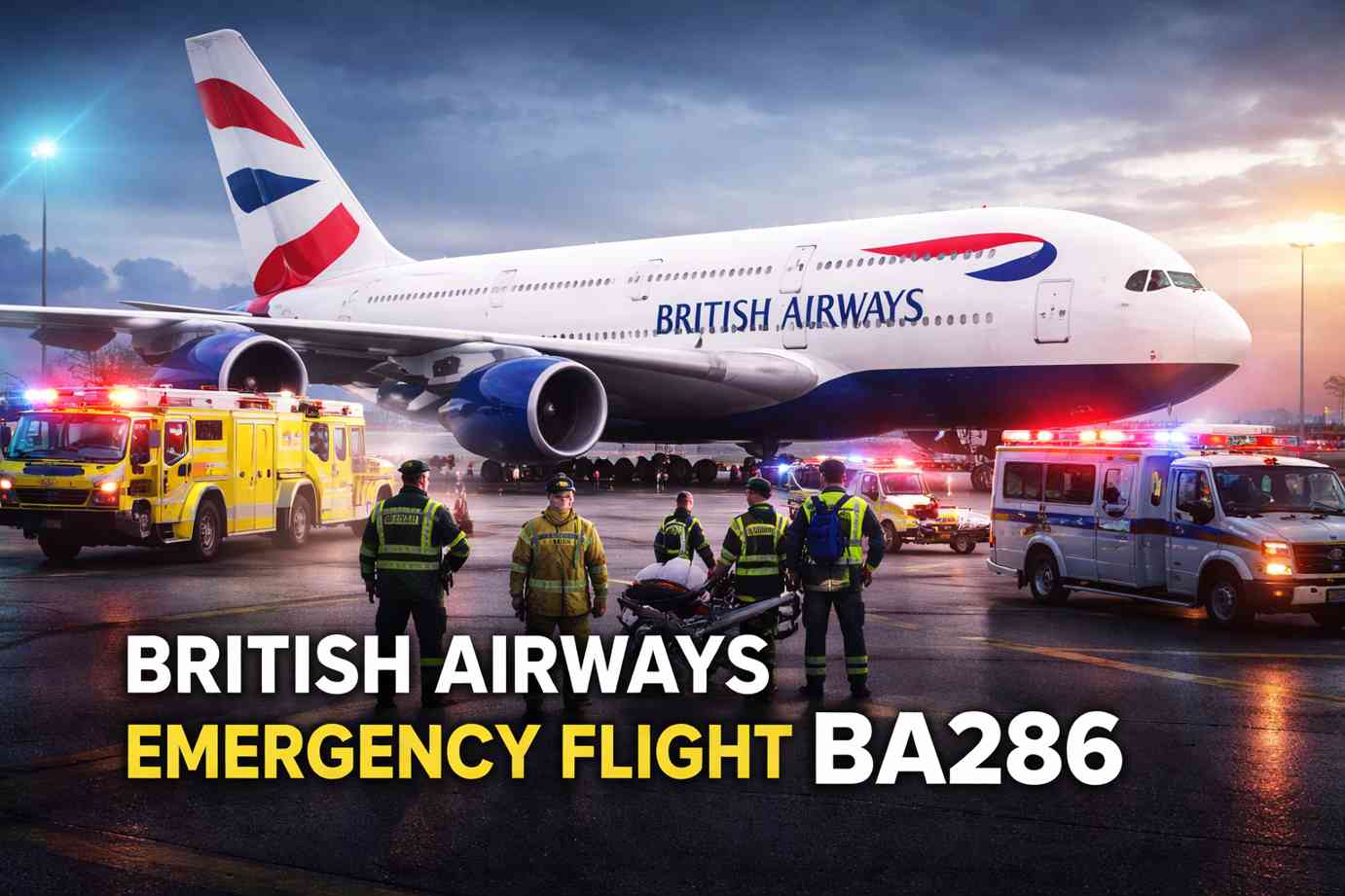
British Airways emergency flight BA286 is a search term linked to rare but well-documented safety events involving a long-haul British Airways service. The flight number BA286 operates on the transatlantic route between San Francisco International Airport in the United States and London Heathrow Airport in the United Kingdom. The term “emergency” does not relate to a crash. It relates to safety procedures activated during specific flights under the BA286 designation.
This article explains everything known about British Airways emergency flight BA286 using verified aviation facts, structured clarity, and simple English. It separates incidents, explains causes, defines aviation terms, and answers common questions in one complete resource.
How British Airways flight BA286 normally operates
British Airways flight BA286 is a scheduled international passenger service. The flight connects the west coast of the United States with the United Kingdom.
Key operational facts about BA286
| Attribute | Details |
|---|---|
| Airline | British Airways |
| Flight Number | BA286 |
| Route | San Francisco (SFO) to London Heathrow (LHR) |
| Flight Type | Long-haul international |
| Typical Aircraft | Airbus A380, Boeing 777 |
| Average Flight Time | 10 to 11 hours |
BA286 operates under standard international aviation regulations. The aircraft, crew, and flight planning follow rules defined by the UK Civil Aviation Authority, the US Federal Aviation Administration, and international aviation bodies.
Why the term “emergency” is linked to BA286
The term “British Airways emergency flight BA286” refers to two separate situations where emergency procedures were used. These situations occurred in different years and involved different causes.
The flight number remained the same. The events were not connected.
The October 2016 BA286 emergency diversion explained
What happened during the 2016 BA286 flight
In October 2016, British Airways flight BA286 departed San Francisco for London. Several hours into the flight, multiple cabin crew members began to feel unwell. Symptoms were reported across the upper deck of the aircraft.
Reported crew symptoms
-
Dizziness
-
Nausea
-
Headache
-
Confusion
-
Metallic or unusual smell perception
The cockpit crew assessed the situation using standard safety procedures.
See More: Understanding Jacksonville Flight Discontinuations
Why the aircraft diverted to Vancouver
Emergency communication used
The pilots issued a PAN PAN call. PAN PAN is an international aviation urgency signal. It indicates a serious situation that is not an immediate danger to the aircraft.
Diversion decision process
The aircraft did not divert to the nearest airport by distance. It diverted to the most suitable airport for safety and aircraft support.
Vancouver International Airport was selected because:
-
It supports large aircraft such as the Airbus A380
-
It provides advanced medical facilities
-
It allows safe off-loading of passengers and crew
The aircraft landed safely with emergency services on standby.
Medical response after landing
After landing in Vancouver:
-
Emergency medical teams boarded the aircraft
-
Crew members were evaluated at hospitals
-
Passengers remained onboard or disembarked safely
-
No passenger required emergency hospitalization
The aircraft did not show visible smoke or fire damage.
Investigation into the 2016 BA286 incident
Airline findings
British Airways engineers inspected the aircraft. The airline stated that no mechanical fault was confirmed.
Environmental concern discussion
Some reports described the incident as a possible “fume event.” A fume event refers to unusual cabin air contamination, often associated with odor complaints. No official public report confirmed toxic exposure.
Outcome classification
Aviation authorities classified the event as a precautionary crew illness incident. The aircraft was not grounded permanently.
The May 2025 BA286 emergency signal explained
Years later, the same flight number appeared in aviation tracking systems again under emergency conditions.
What occurred in 2025
Flight BA286 transmitted the emergency transponder code 7700 during flight. Squawk 7700 is the global code for a general emergency.
Reported cause
Available aviation data linked the emergency code to a medical issue onboard. No engine failure, structural issue, or cabin fire was reported.
Landing outcome
-
The aircraft continued to its destination
-
It landed safely at London Heathrow
-
Emergency vehicles were present as a precaution
-
No injuries were reported publicly
Understanding aviation emergency codes used by BA286
PAN PAN signal
PAN PAN indicates urgency. It is used when safety is affected but immediate danger is not present.
Squawk 7700
Squawk 7700 indicates a general emergency. It alerts air traffic control to give priority handling.
Key distinction
Neither PAN PAN nor 7700 automatically means aircraft failure. Medical emergencies often use these signals.
Passenger safety during BA286 emergencies
Passenger safety remained intact during all reported BA286 incidents.
Safety outcomes
-
Zero fatalities
-
Zero aircraft damage
-
Safe landings in all cases
-
Controlled emergency responses
Airline duty of care
British Airways followed international safety obligations by prioritizing health and risk prevention.
Why BA286 incidents attract high public interest
Several factors increase public attention:
-
Use of emergency signals
-
High passenger capacity aircraft
-
Long-haul international route
-
Reuse of the same flight number
Search engines often surface older and newer incidents together, creating confusion.
Clarifying myths about British Airways emergency flight BA286
Common misunderstandings corrected
-
BA286 did not crash
-
BA286 did not suffer engine failure
-
BA286 did not depressurize
-
BA286 incidents were not linked
Each event occurred independently and followed aviation safety standards.
How British Airways handles in-flight emergencies
British Airways follows a structured emergency management system.
Core response steps
-
Identify safety risk
-
Communicate with air traffic control
-
Select safest diversion or continuation
-
Prepare cabin and medical response
-
Land with emergency support
These steps apply to medical, technical, and environmental concerns.
How to verify BA286 emergency reports independently
Passengers and researchers can confirm information using aviation platforms.
Reliable verification sources
-
Flight tracking services
-
Airport arrival records
-
Official airline statements
-
Aviation authority databases
Cross-checking reduces misinformation.
Comparison of BA286 emergency events
| Feature | 2016 Incident | 2025 Incident |
|---|---|---|
| Emergency Type | Crew illness | Medical emergency |
| Signal Used | PAN PAN | Squawk 7700 |
| Diversion | Yes (Vancouver) | No |
| Passenger Impact | Minimal | Minimal |
| Landing Outcome | Safe | Safe |
Frequently Asked Questions about British Airways emergency flight BA286
What is British Airways emergency flight BA286?
British Airways emergency flight BA286 refers to flights using the BA286 number that activated emergency procedures during specific incidents.
Did BA286 ever crash?
BA286 has never crashed. All reported incidents ended with safe landings.
Why did BA286 divert to Canada in 2016?
The flight diverted due to multiple crew members feeling unwell and needing medical evaluation.
What caused the BA286 emergency in 2025?
A medical issue onboard triggered the emergency transponder code.
Is BA286 considered unsafe?
BA286 operates under normal safety standards. Emergency events are rare and managed professionally.
Does an emergency code mean aircraft failure?
Emergency codes often relate to medical or precautionary situations, not mechanical failure.
Key takeaways about British Airways emergency flight BA286
-
BA286 is a standard long-haul British Airways route
-
Emergency events occurred in different years for different reasons
-
No passengers were seriously harmed
-
Aviation safety systems functioned correctly
-
Emergency does not equal danger or crash
Conclusion
British Airways emergency flight BA286 represents how modern aviation safety systems work during rare and unexpected situations. The incidents linked to BA286 involved precaution, medical response, and controlled decision-making. The aircraft landed safely each time. Crew training, emergency signaling, and international coordination ensured passenger safety.